

$60.00 Original price was: $60.00.$45.00Current price is: $45.00.
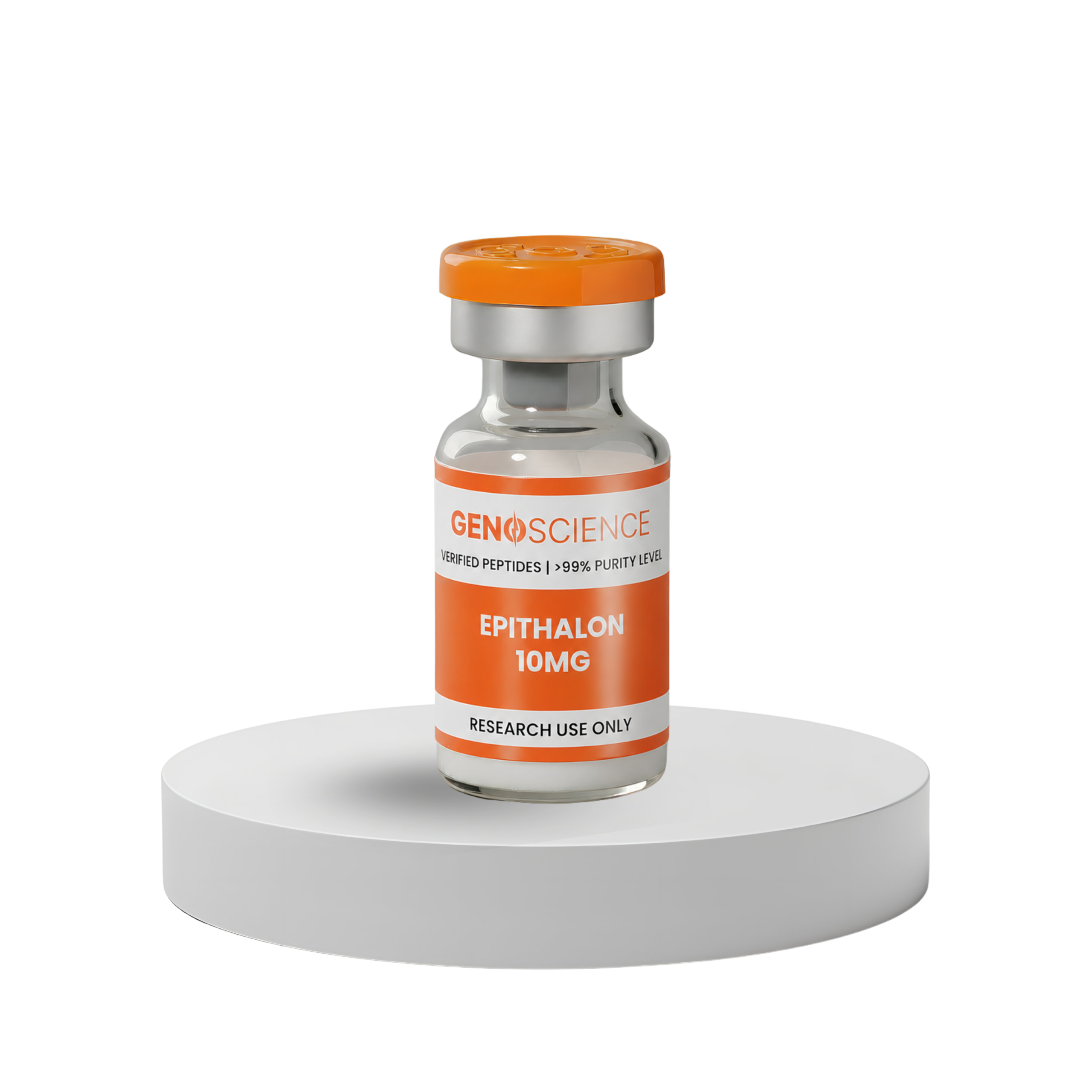
Compound: Epithalon (Epitalon, AEDG)
Amount: 10mg per vial
Format: Lyophilized Powder
Chemical Classification: Synthetic Tetrapeptide
Amino-Acid Sequence: Ala-Glu-Asp-Gly (AEDG)
Chemical Profile: Epithalon, also spelled epitalon, is a defined four-amino-acid peptide investigated in laboratory studies of cellular gene expression and telomere-associated biology. It was developed as a synthetic peptide within a research program examining pineal-derived peptide preparations. Its scientific literature includes cultured-cell studies involving telomerase-associated measurements.
Research Use Only. Not for human or veterinary use.
Monthly subscription three vials of 10mg for a total of 30mg was $135 now $110
Epithalon, also spelled Epitalon, is a synthetic tetrapeptide containing four amino acids: alanine, glutamic acid, aspartic acid and glycine. Its sequence is commonly written AEDG.
The compound was developed in a scientific program involving peptide bioregulators and investigations of pineal-derived preparations. The name Epithalon refers to a defined synthetic four-residue sequence rather than to a complex tissue extract.
| Specification | Details |
|---|---|
| Compound | Epithalon |
| Alternative Spellings | Epitalon, Epithalone |
| Research Name | AEDG Tetrapeptide |
| Classification | Synthetic Tetrapeptide |
| Amino-Acid Length | 4 Residues |
| Amino-Acid Sequence | Ala-Glu-Asp-Gly |
| Molecular Formula | C14H22N4O9 |
| Molecular Weight | Approximately 390.35 g/mol |
| CAS Number | 307297-39-8 |
| Product Form | Lyophilized Powder |
| Amount | 10mg per Vial |
| Research Category | Peptide Bioregulator and Cellular Research |
Ala-Glu-Asp-Gly or AEDG.
The peptide’s simple four-residue sequence distinguishes it from longer polypeptides and from multicomponent extracts.
Epithalon and epithalamin are related historically but not chemically identical.
This distinction is important when interpreting papers that use similar terminology for different substances.
Epithalon provides a defined four-amino-acid sequence for studying peptide structure and activity in experimental biological systems.
Short peptides can be characterized by their sequence, terminal groups and molecular properties. Researchers investigating epithalon distinguish the synthetic peptide from heterogeneous pineal extracts or other peptide bioregulator preparations.
A 2003 study reported measurements of telomerase activity and telomere length in cultured human cells exposed to epithalon under experimental conditions.
Telomerase is an enzyme involved in the maintenance of chromosome-end structures known as telomeres. Measuring telomerase activity is a cellular research endpoint.
The original findings provide scientific background for studies of epithalon and telomere-associated pathways.
Telomeres are repeated DNA structures at chromosome ends. Researchers examine them using cell cultures and analytical methods that measure changes in telomere-related markers.
Epithalon literature includes observations made in cultured human cells. Interpretation depends on the cell line, experimental conditions, measurement technique and control groups.
In this research context, results from a small set of cell lines do not establish an outcome in a whole organism.
Some early experiments explored how epithalon exposure relates to the proliferative behavior of cultured cells across multiple passages.
These experiments studied defined cell populations under laboratory conditions. The behavior of one cell type may differ from another.
Research into short peptide bioregulators includes investigations of whether peptides are associated with changes in gene expression or cellular regulatory pathways.
In the case of epithalon, research has considered telomerase-associated gene expression. Such studies remain mechanistic and depend on the measurement methods and biological system.
The early epithalon literature includes a concentrated body of work from a limited number of research groups. This makes careful interpretation and independent replication important.
More recent cell-based studies have examined telomere-related endpoints in additional models. The overall scientific context remains largely laboratory-based.
Certificates of Analysis (COAs) are posted on the product page when available. To request documentation for a specific lot, contact the Genoscience team with the lot number.
Store unopened lyophilized research material at −20 °C, protected from moisture and light. Allow the sealed vial to reach room temperature before opening to reduce condensation.
Handle with suitable laboratory protective equipment and applicable research-facility procedures.
Research Use Only: This product is intended strictly for laboratory research and development.
Not for Human or Veterinary Use: Not intended for human consumption, administration or veterinary applications.
Not an Approved Medicine: Epithalon research material is not marketed as an FDA-approved drug or treatment.
Research Limitations: Telomerase and telomere measurements in cultured cells do not establish clinical safety or efficacy for this product.
Epithalon is a synthetic four-amino-acid peptide with the sequence Ala-Glu-Asp-Gly (AEDG). It is studied in peptide bioregulator and cellular research.
Yes. Epithalon and Epitalon are two spellings commonly used for the same synthetic AEDG tetrapeptide.
Epithalon is one defined synthetic tetrapeptide. Epithalamin refers to a complex preparation historically associated with pineal tissue extracts.
Some published studies have examined cultured-cell markers related to telomerase, telomeres and cellular proliferation. These are laboratory measurements rather than established clinical outcomes.
AEDG is the one-letter abbreviation for the amino-acid sequence alanine, glutamic acid, aspartic acid and glycine.
When available, the COA for Epithalon 10mg can be found on the product page. You may also contact Genoscience to request a COA or ask about documentation availability for a specific lot.
No. Genoscience sells Epithalon 10mg strictly for laboratory research purposes. It is not intended for human or veterinary use.
$70.00 Original price was: $70.00.$50.00Current price is: $50.00.
$50.00 Original price was: $50.00.$30.00Current price is: $30.00.
$85.00 Original price was: $85.00.$60.00Current price is: $60.00.
$70.00 – $130.00Price range: $70.00 through $130.00
$150.00 Original price was: $150.00.$100.00Current price is: $100.00.
You must be at least 21 years old to enter Genoscience and review products intended for laboratory research use only.
Products are not for human or veterinary use, not for use in diagnostic procedures, and have not been evaluated by the U.S. Food and Drug Administration.