
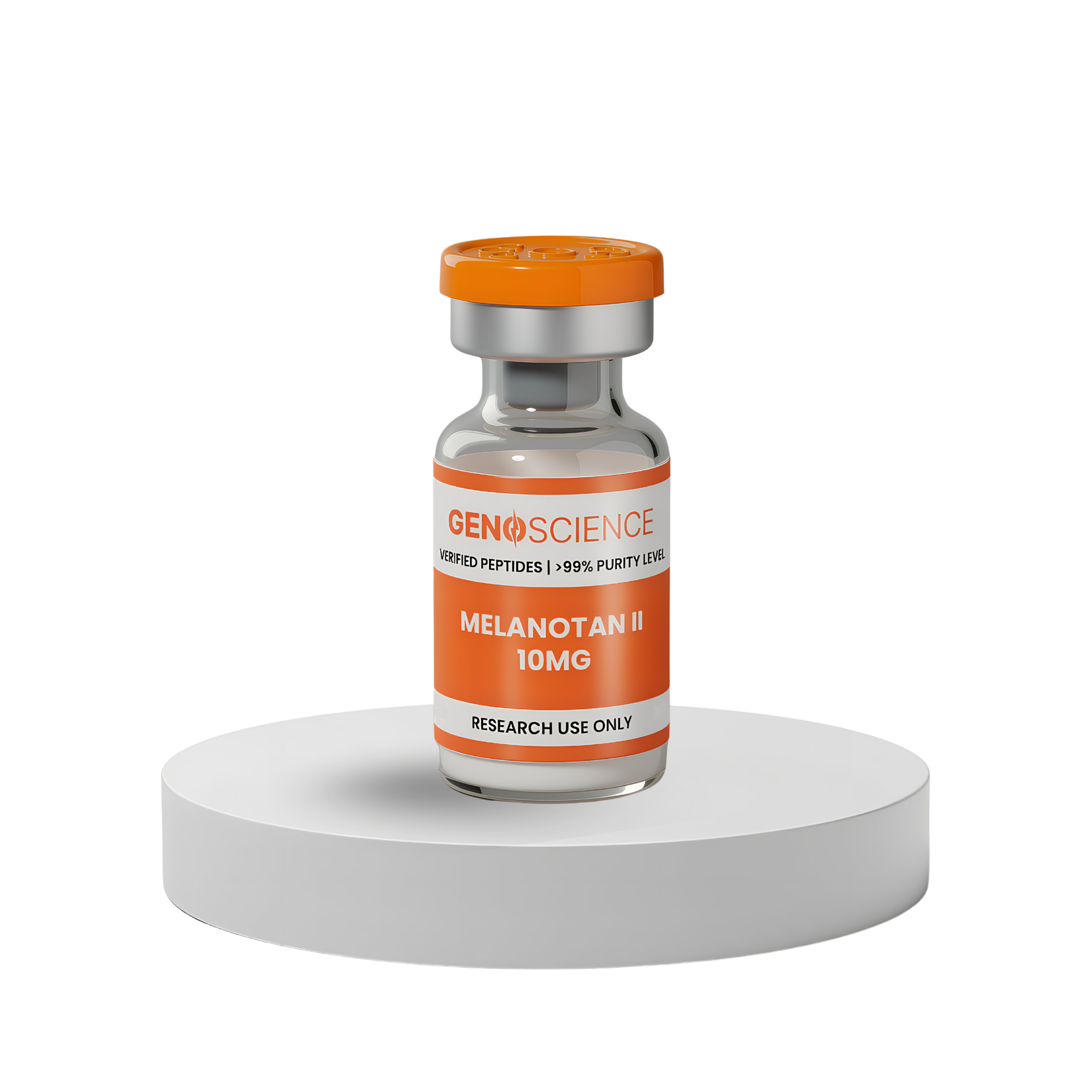




One vial 10 mg was $60 now $35
Compound: Melanotan II (MT-II)
Amount: 10mg per vial
Format: Lyophilized Powder
Chemical Classification: Synthetic Cyclic Melanocortin-Receptor Peptide Analog
Research Targets: Melanocortin Receptor Family, including MC1R, MC3R, MC4R and MC5R
Chemical Profile: Melanotan II is a synthetic cyclic heptapeptide related to the alpha-melanocyte-stimulating hormone (α-MSH) sequence. It is investigated as a research ligand in melanocortin receptor pharmacology, including receptor recognition and intracellular signaling assays. Its cyclic structure distinguishes it from longer linear melanocortin-related peptides.
Research Use Only. Not for human or veterinary use.
Melanotan II, also written MT-II, is a synthetic cyclic seven-residue peptide based on the melanocortin research family. It was developed as an analog of alpha-melanocyte-stimulating hormone (α-MSH).
The peptide contains a ring-forming structural arrangement and nonstandard amino-acid features. Melanotan II has been investigated for activity across several melanocortin receptor subtypes rather than being described as a receptor-specific ligand for just one subtype.
| Specification | Details |
|---|---|
| Compound | Melanotan II |
| Synonym | MT-II |
| Classification | Synthetic Cyclic Heptapeptide |
| Molecular Formula | C50H69N15O9 |
| Molecular Weight | Approximately 1,024.2 g/mol |
| CAS Number | 121062-08-6 |
| Research Targets | MC1R, MC3R, MC4R and MC5R |
| Structural Characteristic | Cyclic Peptide Core |
| Form | Lyophilized Powder |
| Amount | 10mg per Vial |
| Intended Use | Laboratory Research Only |
Ac-Nle-cyclo[Asp-His-D-Phe-Arg-Trp-Lys]-NH2
This notation indicates a cyclic peptide framework with an acetylated norleucine feature and a C-terminal amide. Its molecular structure differs from the more linear framework of naturally occurring α-MSH.
Melanotan I, also known as afamelanotide, is a longer linear α-MSH analog. Melanotan II is a shorter cyclic peptide associated with a broader research receptor profile.
Their chemical structures, sequence lengths and receptor-signaling characteristics are not interchangeable.
PT-141, also called bremelanotide, is a related cyclic research ligand. One structural difference is the terminal group: Melanotan II is amidated, while bremelanotide has a free acid at the corresponding position.
Melanotan II is a research ligand of the melanocortin receptor family. These receptors are class A G-protein-coupled receptors and are studied in different biological systems.
The melanocortin family includes MC1R through MC5R. Laboratory studies distinguish receptor-subtype responses rather than assuming that each receptor interacts identically with a given ligand.
MC1R is a melanocortin receptor associated with research on melanocyte signaling and pigmentation-related molecular pathways.
Melanotan II has been investigated in receptor and cell-culture systems involving MC1R. Such experiments may measure intracellular signaling and gene-expression markers.
These are experimental cellular endpoints.
MC3R and MC4R are receptor subtypes discussed in research involving neuroendocrine and neuronal signaling networks.
Researchers may use melanocortin ligands to compare signaling responses across receptor subtypes in defined cell lines or biochemical systems. Such measurements provide information about receptor engagement and activity.
Melanotan II is an example of a peptide in which part of the chain forms a ring. Cyclic peptide chemistry is a recognized area of structure–activity research.
Scientists study how constraints imposed by a cyclic framework affect ligand recognition, relative receptor activity and molecular conformation. The properties of a cyclic peptide can differ from those of a linear peptide with a related sequence.
Melanotan II and PT-141 share a closely related cyclic core but differ in terminal chemistry. These compounds provide an instructive comparison when examining how small modifications influence receptor behavior.
The comparison is relevant to molecular pharmacology and does not imply that both compounds have the same full receptor profile in every assay.
A common goal of melanocortin ligand research is to characterize potency and activity across several receptor targets. Experiments can use receptor-expressing cells, binding measurements and second-messenger assays.
Appropriate interpretation requires identifying the receptor subtype, ligand and test environment. A broad family label does not replace data describing each receptor’s response.
Certificates of Analysis (COAs) are posted on the product page when available. To request documentation for a specific lot, contact the Genoscience team with the lot number.
Keep unopened lyophilized research material at −20 °C, dry and protected from moisture and light. Allow the sealed vial to reach room temperature before opening to reduce condensation.
Handle using suitable laboratory protective equipment and standard research-facility procedures.
Research Use Only: This product is intended strictly for laboratory research and development.
Not for Human or Veterinary Use: Not intended for human consumption, administration or veterinary applications.
Not an Approved Medicine: This research material is not marketed as an FDA-approved drug or treatment.
Research Limitations: Melanocortin receptor and cell-culture studies do not establish clinical safety or efficacy for this product.
Melanotan II is a synthetic cyclic heptapeptide associated with the α-MSH research family and used in studies of melanocortin receptor signaling.
The compound is discussed in experiments involving melanocortin receptors such as MC1R, MC3R, MC4R and MC5R.
Melanotan I is a longer linear α-MSH analog. Melanotan II is a shorter cyclic peptide with a distinct chemical structure.
Both are related cyclic melanocortin peptides. PT-141 has a free C-terminal acid, while Melanotan II has a C-terminal amide.
Genoscience lists it as 10mg of lyophilized research material per vial.
When available, the COA for Melanotan II 10mg can be found on the product page. You may also contact Genoscience to request a COA or ask about documentation availability for a specific lot.
No. Genoscience sells Melanotan II 10mg strictly for laboratory research purposes. It is not intended for human or veterinary use.
$120.00 Original price was: $120.00.$100.00Current price is: $100.00. / month
$160.00 Original price was: $160.00.$120.00Current price is: $120.00. / month
$300.00 Original price was: $300.00.$100.00Current price is: $100.00. / month
$300.00 Original price was: $300.00.$180.00Current price is: $180.00. / month
$135.00 Original price was: $135.00.$75.00Current price is: $75.00. / month
$220.00 Original price was: $220.00.$180.00Current price is: $180.00. / month
You must be at least 21 years old to enter Genoscience and review products intended for laboratory research use only.
Products are not for human or veterinary use, not for use in diagnostic procedures, and have not been evaluated by the U.S. Food and Drug Administration.