
How to Evaluate Research Peptide Documentation: COAs, Identity Testing, and Batch Traceability
Introduction to Evaluating Research Peptides & Documentation
A research material should be evaluated through traceable documentation, not through a product name or a single headline purity value. For peptide work, researchers may need to understand identity, sequence, quantity, impurities, degradation, storage history, and the relationship between a supplied lot and the analytical report that describes it. Documentation cannot replace a study design or laboratory controls, but it can help researchers decide whether a material record is sufficiently clear for their own work.
This guide explains how to read a Certificate of Analysis (CoA), understand common analytical terms, and build a reproducible material record. It is for laboratory research and education only. It is not medical, diagnostic, therapeutic, dosing, administration, or human-use guidance.
What a Certificate of Analysis can tell you
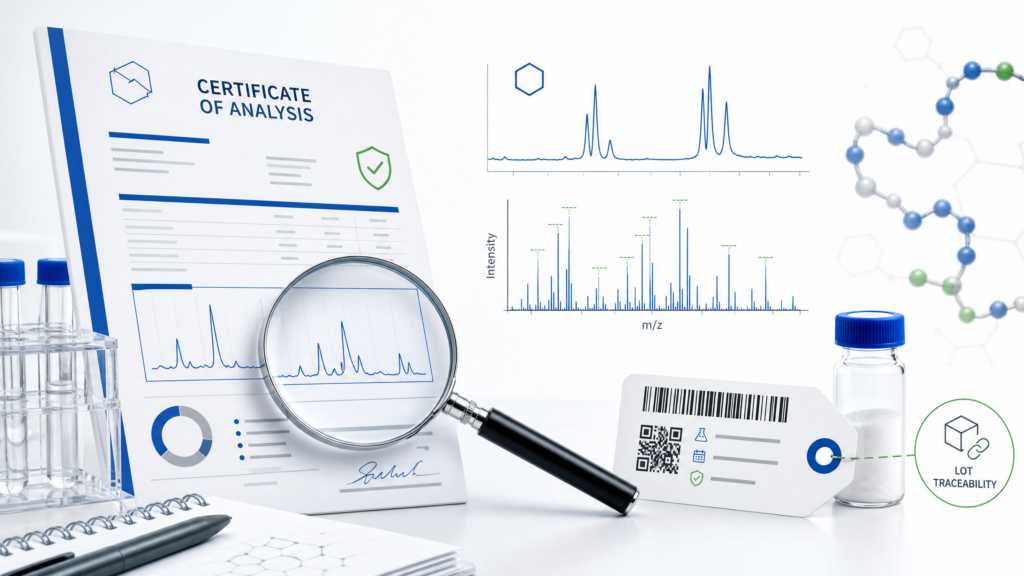
A CoA is a document that reports selected results for a defined product or lot. Typical fields may include the material name, lot or batch number, date of testing, stated quantity, analytical method, reported result, specification, and testing laboratory. The exact format varies between suppliers and laboratories. A CoA should therefore be read as a record of the tests reported in that document, not as a universal guarantee of every property a researcher might care about.
The first review question is traceability: does the CoA clearly identify the same lot supplied to the researcher? The product name, lot number, quantity, date, and package label should be compared. If the material and document cannot be connected, it becomes harder to interpret an unexpected result or reproduce the study later.
Identity, purity, and content are different attributes
Identity asks whether the material corresponds to the expected molecular entity. Purity usually describes the proportion of detected material under a particular analytical method, often relative to related signals in a chromatographic profile. Content or assay may refer to the amount of peptide or the assigned value of a material, depending on the method and reporting convention. These terms should not be treated as interchangeable.
Synthetic-peptide quality work can involve characterization of primary sequence, impurities, degradation products, aggregation state, content, and stability. A peer-reviewed study on peptide reference standards describes the use of methods including mass spectrometry, chromatography, HPLC, NMR, content assignment, and stability studies [1]. The exact method and its suitability matter as much as the label applied to the result.
HPLC and chromatographic results
High-performance liquid chromatography, or HPLC, separates components in a sample according to their interaction with a stationary phase and a mobile phase. In peptide documentation, a chromatogram may show a principal peak and additional peaks that may correspond to related substances, impurities, degradation products, or other detectable components depending on the method used. A reported area percentage can be useful, but it is not a complete description of the material.
Researchers should look for the method name, column or separation conditions where reported, detection wavelength, sample information, and whether the result is area-based or otherwise assigned. Different methods can produce different profiles. A result from one method should not automatically be compared with a result from a different method as if the numbers were identical measurements.
Mass spectrometry and molecular-mass evidence
Mass spectrometry can provide information about the mass-to-charge characteristics of ions derived from a sample. In peptide characterization, this may support an identity assessment by comparing an observed mass with an expected mass. Interpretation can be affected by adducts, charge states, modifications, sample preparation, instrument resolution, and the presence of closely related species.
A mass result is not the same as a full sequence confirmation, and a matching mass does not establish sterility, biological activity, stability, or suitability for a particular assay. The method, instrument, sample preparation, and interpretation should be considered together. Where a research question requires a stronger identity assessment, the laboratory should select methods appropriate to that question.
Lot matching and chain of custody
A useful documentation system connects the material received with its supplier record, package label, CoA, storage record, and study notebook. Researchers should record the date received, product identifier, lot number, stated quantity, package condition, storage location, temperature requirements, preparation details, and any deviations. If the material is transferred to another container, the new container should retain a traceable identifier.
This record is not merely administrative. Peptides can be affected by moisture, temperature, light, oxidation, adsorption, aggregation, and repeated handling. A clear chain of custody helps researchers investigate whether a result may be related to the material, storage, preparation, assay, or analysis.
What a purity percentage does not establish
A reported purity percentage should not be treated as proof of sterility, endotoxin status, absence of all impurities, long-term stability, performance in a biological assay, or suitability for human or veterinary use. Those characteristics require separate evidence and, where relevant, separate testing. The absence of a test result should not be silently converted into a positive claim.
This distinction is especially important for public-facing content. A research supplier can explain what a document reports while avoiding the implication that a laboratory report guarantees a specific experimental outcome. Claims about identity, purity, quantity, or other quality attributes should be limited to what is supported by the applicable analytical documentation for the specific lot and method used.
Questions researchers can ask
Researchers comparing documentation can ask: What is the exact material identifier? Is the sequence or molecular description stated? Does the document identify the lot? Which laboratory performed the testing? Which methods were used? Is the reported purity area-based or assigned by another approach? Is content reported separately from purity? Are storage and shipping conditions described? Are test dates and document versions clear? Can the supplier explain which attributes were not tested?
These questions do not require every supplier to use the same document format. They help the researcher understand the evidence behind each statement and determine whether additional confirmation is needed for the intended study.
Building a reproducible study record
A study record should include the material name, identifier, lot number, source, stated amount, receipt date, storage conditions, preparation solvent, concentration calculation, preparation date, freeze-thaw history, assay system, controls, and relevant analytical documents. If a result is later questioned, these details make it possible to reconstruct the experiment.
Researchers should also preserve the original CoA and record any later correction or replacement. A revised document should not silently overwrite the earlier version. Where appropriate, the laboratory can maintain a version history and note who reviewed the document.
Research Use Only notice
This article is provided solely for laboratory research education and scientific information. Any research materials referenced by Genoscience are intended exclusively for qualified laboratory research and are not medicines, diagnostic products, dietary supplements, or treatments. They are not intended for human or veterinary use. This article does not provide instructions for administration, dosing, self-experimentation, or clinical decision-making. Product identity, purity, storage, quality, and compliance statements should be reviewed against the applicable lot documentation and by qualified scientific, legal, and regulatory professionals where appropriate.
Conclusion
Good research documentation is specific, lot-linked, method-aware, and transparent about limitations. A CoA can be a useful part of a material record, but it should be interpreted together with the analytical method, sample identity, storage history, and requirements of the study. By explaining these distinctions clearly, a research library can provide greater scientific value than a generic list of purity claims. Analytical results should be interpreted within the limits of the methods used and should not be extrapolated into unsupported claims about biological performance, sterility, or suitability for human or veterinary use.
References
[1] McCarthy D, Han Y, Carrick K, et al. “Reference Standards to Support Quality of Synthetic Peptide Therapeutics.” Pharmaceutical Research 40 (2023): 1317–1328. https://doi.org/10.1007/s11095-023-03493-1