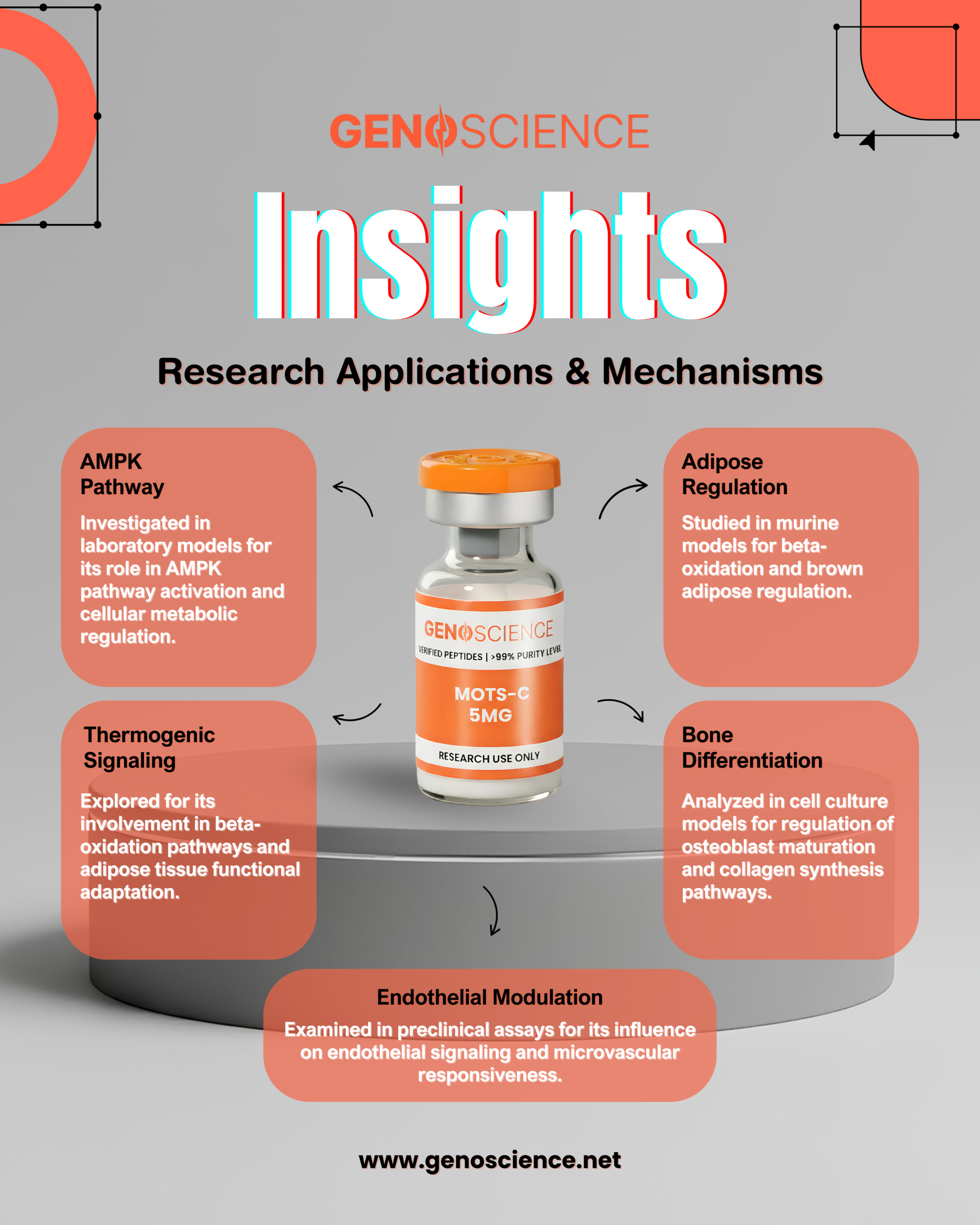
- AMPK Activation & Metabolic Homeostasis MOTS-c is a primary subject of research regarding the “Folate-Methionine Cycle.” Laboratory models indicate that MOTS-c targets this cycle to increase cellular levels of AICAR (5-aminoimidazole-4-carboxamide ribonucleotide), which subsequently activates AMPK (AMP-activated protein kinase). Researchers use this peptide to model how AMPK activation can drive glucose and fatty acid uptake in skeletal muscle independent of the insulin signaling pathway.
- Adipose Tissue Regulation & Thermogenesis In murine models of obesity, MOTS-c is investigated for its role in regulating sphingolipid and monoacylglycerol metabolism. Research indicates that administration of the peptide may increase beta-oxidation and enhance the function of Brown Adipose Tissue (BAT). This pathway is critical for studying the prevention of adipose inflammation and the “browning” of white fat—a key area of interest in metabolic syndrome research.
- Osteogenesis & Bone Density Research in osteoblast cell lines suggests that MOTS-c regulates the TGF-beta/SMAD signaling pathway, which is responsible for osteoblast survival and maturation. Furthermore, studies have observed that MOTS-c promotes the differentiation of bone marrow stem cells into bone-forming cells. This makes it a vital reagent for researching osteoporosis pathophysiology and type I collagen synthesis rates.
- Endothelial Function & Microvascular Health In cardiovascular research, MOTS-c is studied for its interaction with endothelial cells. While it does not directly contract vessels, rat models suggest it sensitizes endothelial cells to cholinergic signaling (acetylcholine). This mechanism is being explored to understand how mitochondrial peptides influence microvascular responsiveness and protect against endothelial dysfunction and reperfusion injury.
- Longevity & Genetic Polymorphisms MOTS-c is a target of anthropological and genetic research due to the “m.1382A>C” polymorphism found in certain centenarian populations (specifically of Northeast Asian ancestry). This genetic variation results in a K14Q substitution (Glutamate replacing Lysine at position 14). Researchers are investigating how this structural change affects the peptide’s bioactivity and its potential role in extending “healthspan” and delaying cellular senescence.
Important Notices:
- Research Use Only: This product is sold strictly for scientific research and development purposes.
- Handling: The product is provided as a lyophilized powder. Reconstitution requires bacteriostatic water and sterile laboratory equipment (syringes, needles, alcohol pads), which are not included.
- Visuals: Vial appearance and cap color may vary from product photos; the label quantity refers to the total active content inside the vial.
Disclaimer: This product is sold explicitly as a chemical reagent for laboratory research and testing purposes only. It is not intended for human consumption, diagnostic, or therapeutic use. Bodily introduction of any kind into humans or animals is strictly forbidden by law.