
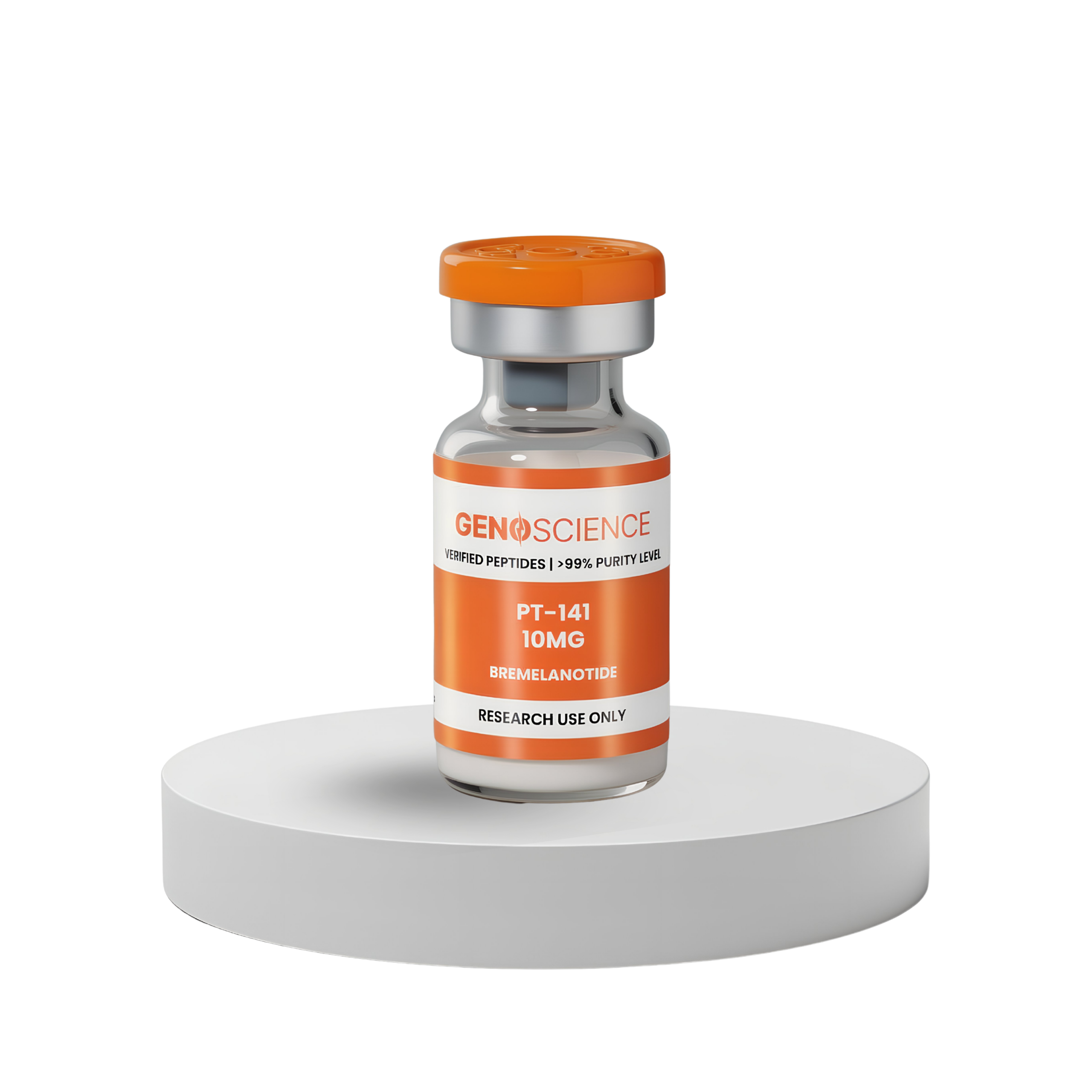




Compound: PT-141 (Bremelanotide)
Amount: 10mg per vial
Format: Lyophilized Powder
Chemical Classification: Synthetic Cyclic Melanocortin-Related Heptapeptide
Research Targets: Melanocortin Receptor Family, including MC3R and MC4R
Chemical Profile: PT-141, also known as bremelanotide, is a synthetic cyclic seven-residue peptide investigated in melanocortin receptor pharmacology. Its cyclic amino-acid framework is related to melanotan II, but the two compounds differ in their terminal chemistry. PT-141 is discussed in structure–activity studies of melanocortin receptor ligands and receptor-signaling selectivity.
Research Use Only. Not for human or veterinary use.
PT-141, also called bremelanotide, is a synthetic cyclic heptapeptide derived from research on melanocortin-family ligands. Its chemical structure contains a cyclic peptide core and an N-terminal acetylated norleucine component.
The compound belongs to the broader family of analogs related to alpha-melanocyte-stimulating hormone (α-MSH). Scientific research has examined how cyclic structure and terminal-group modifications influence interactions with different melanocortin receptors.
| Specification | Details |
|---|---|
| Compound | PT-141 |
| Synonym | Bremelanotide |
| Classification | Synthetic Cyclic Heptapeptide |
| Molecular Formula | C50H68N14O10 |
| Molecular Weight | Approximately 1,025.2 g/mol |
| CAS Number | 189691-06-3 |
| Research Targets | Melanocortin Receptors, Especially MC3R and MC4R |
| Structural Feature | Cyclic Peptide Core |
| Product Form | Lyophilized Powder |
| Amount | 10mg per Vial |
| Intended Use | Laboratory Research Only |
Ac-Nle-cyclo[Asp-His-D-Phe-Arg-Trp-Lys]-OH
The notation indicates a cyclic peptide framework containing both standard and nonstandard amino-acid features, including D-phenylalanine.
PT-141 and melanotan II share a related cyclic melanocortin peptide framework. A key difference is the C-terminal chemical group: bremelanotide contains a free acid, while melanotan II includes a C-terminal amide.
This difference is relevant to the study of ligand structure and receptor-subtype interactions. The two peptides should not be described as chemically identical.
PT-141 is studied within the melanocortin receptor family, a group of G-protein-coupled receptors commonly abbreviated MC1R through MC5R.
This receptor family participates in several biological signaling systems. Experimental receptor studies examine how a defined ligand engages individual subtypes and produces measurable downstream responses.
The scientific literature on bremelanotide includes investigations involving MC3R and MC4R. These receptors are part of the melanocortin signaling network and are frequently characterized using receptor-expressing cell systems.
Assays may examine ligand binding and intracellular second-messenger responses. Measurements in such systems are useful for receptor pharmacology and are specific to the assay system used.
Cyclic peptides differ structurally from linear peptide chains because selected amino-acid residues form an internal ring. This structure can influence how a ligand interacts with its molecular targets.
PT-141 provides an example of a cyclic melanocortin-related ligand. Comparisons with related compounds can examine the role of the cyclic core, nonstandard amino-acid residues and terminal groups in receptor recognition.
PT-141 and melanotan II are commonly compared in structure–activity research because they share much of the same peptide core but differ in C-terminal chemistry.
Researchers can use such molecular comparisons to understand how a single structural change influences measured receptor responses. Findings should be interpreted by receptor subtype and assay method.
A ligand may interact with several receptor subtypes at different potencies. Melanocortin research therefore distinguishes broad receptor agonism from more selective activity.
In receptor experiments, investigators may compare signaling profiles across MC3R, MC4R and other family members. Receptor activity should not be described as identical across the family unless supported by the specific assay data.
Certificates of Analysis (COAs) are posted on the product page when available. To request documentation for a specific lot, contact the Genoscience team with the lot number.
Store unopened lyophilized research material at −20 °C in a dry environment, protected from moisture and light. Allow the sealed vial to reach room temperature before opening to reduce condensation.
Use appropriate laboratory protective equipment and established research-facility procedures.
Research Use Only: This Genoscience product is intended strictly for scientific laboratory research and development.
Not for Human or Veterinary Use: Not intended for human consumption, administration or veterinary applications.
Not an Approved Medicine: This material is not marketed as an FDA-approved drug or treatment.
Research Limitations: Published receptor findings do not establish the safety or efficacy of this Genoscience research product.
PT-141, also called bremelanotide, is a synthetic cyclic melanocortin-related peptide with a seven-residue cyclic core.
Yes. Bremelanotide is another name for the chemical compound commonly called PT-141.
The peptides share a related cyclic framework but differ at the C-terminus. PT-141 contains a free acid; melanotan II has a corresponding amide.
Research examines the melanocortin receptor family, particularly MC3R and MC4R, using ligand-binding and signaling experiments.
Genoscience supplies the research material as 10mg of lyophilized powder per vial.
When available, the COA for PT-141 (Bremelanotide) 10mg can be found on the product page. You may also contact Genoscience to request a COA or ask about documentation availability for a specific lot.
No. Genoscience sells PT-141 strictly for laboratory research purposes. It is not intended for human or veterinary use.
$300.00 Original price was: $300.00.$100.00Current price is: $100.00. / month
$600.00 Original price was: $600.00.$450.00Current price is: $450.00. / month
$300.00 Original price was: $300.00.$180.00Current price is: $180.00. / month
$500.00 Original price was: $500.00.$400.00Current price is: $400.00. / month
$450.00 Original price was: $450.00.$275.00Current price is: $275.00. / month
$220.00 Original price was: $220.00.$180.00Current price is: $180.00. / month
You must be at least 21 years old to enter Genoscience and review products intended for laboratory research use only.
Products are not for human or veterinary use, not for use in diagnostic procedures, and have not been evaluated by the U.S. Food and Drug Administration.