
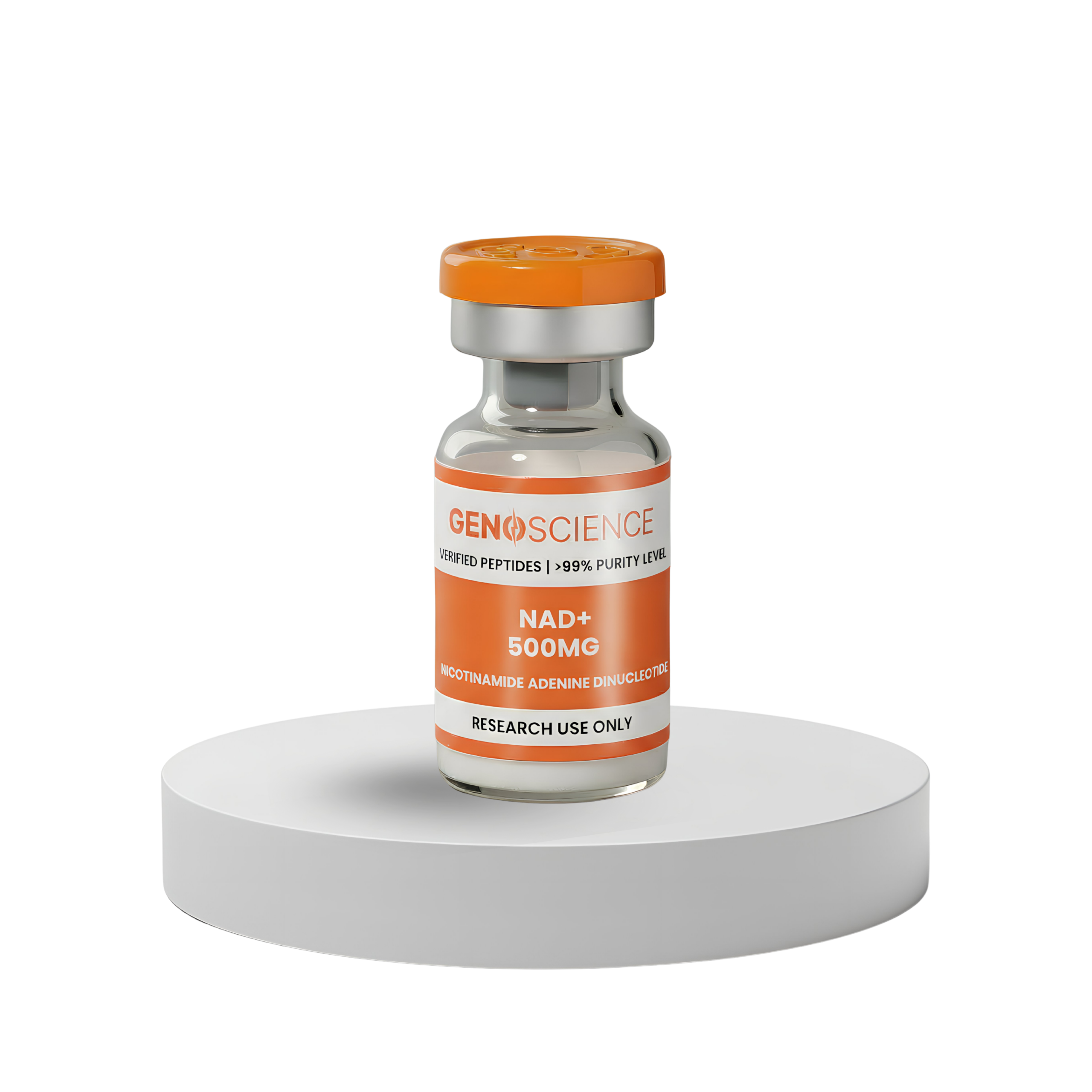
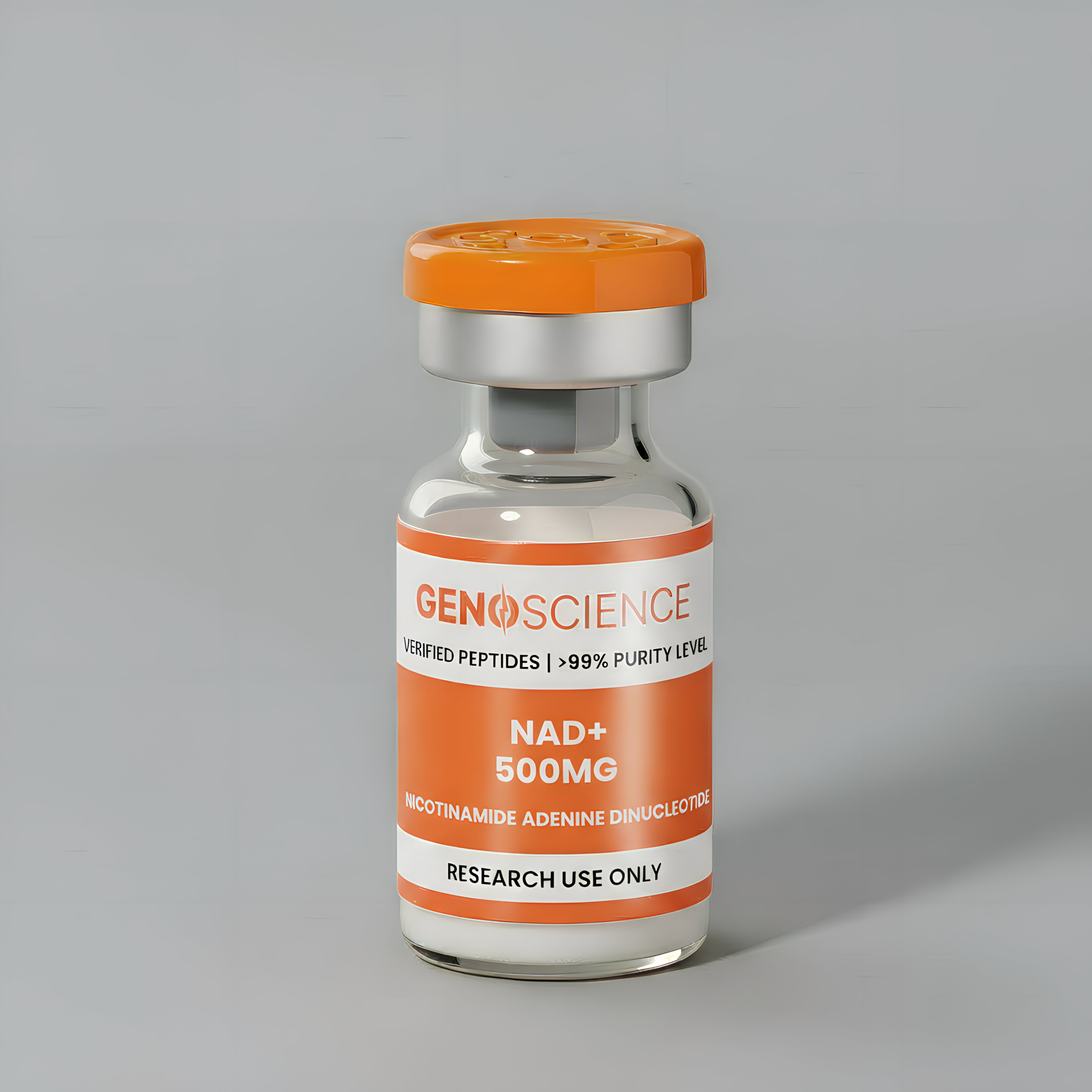

$80.00 Original price was: $80.00.$50.00Current price is: $50.00.
Compound: NAD+ (Nicotinamide Adenine Dinucleotide, Oxidized Form)
Amount: 500mg per vial
Format: Lyophilized Powder
Chemical Classification: Dinucleotide Coenzyme (Not a Peptide)
Research Category: Cellular Redox Reactions and NAD-Dependent Enzyme Research
Chemical Profile: NAD+ is the oxidized form of nicotinamide adenine dinucleotide, an essential coenzyme involved in cellular oxidation–reduction reactions. It is also used as a substrate by multiple enzyme families, including sirtuins, PARPs and CD38. NAD+ is studied in metabolism, enzyme biochemistry and intracellular signaling research.
Research Use Only. Not for human or veterinary use.
NAD+ stands for nicotinamide adenine dinucleotide, in its oxidized form. It is a dinucleotide coenzyme found across living systems and participates in numerous cellular biochemical reactions.
Unlike a peptide, NAD+ is not composed of a chain of amino acids. Its structure consists of two linked nucleotide units, and its research role includes electron-transfer chemistry and interactions with NAD-dependent enzymes.
NAD+ and NADH form an important reversible redox pair. NAD+ accepts electrons during certain enzymatic reactions and is converted to the reduced form, NADH.
| Specification | Details |
|---|---|
| Compound | NAD+ |
| Full Name | β-Nicotinamide Adenine Dinucleotide, Oxidized Form |
| Classification | Dinucleotide Coenzyme |
| Chemical Form | Oxidized NAD |
| Molecular Formula | C21H27N7O14P2 |
| Molecular Weight | Approximately 663.43 g/mol |
| CAS Number | 53-84-9 |
| Product Form | Lyophilized Powder |
| Amount | 500mg per Vial |
| Research Area | Enzyme Biochemistry and Cellular Metabolism |
The two forms are chemically related but are not interchangeable names for the same redox state.
Peptides contain amino acids joined by peptide bonds. NAD+ is a dinucleotide coenzyme. It appears in related laboratory research areas because its chemistry intersects with metabolic pathways that are also investigated using peptide-related tools.
NAD+ is a central cofactor in oxidation–reduction reactions that help cells transfer electrons between molecules. In this role, it can be reduced to NADH as enzymes catalyze biochemical transformations.
Researchers use NAD+-dependent assays to study reaction kinetics, substrate turnover and enzyme activity. These experiments are part of foundational biochemistry and do not depend on human-use interpretations.
NAD+ participates in redox steps associated with cellular pathways including glycolysis and the citric acid cycle.
In controlled biochemical systems, the conversion between NAD+ and NADH provides a measurable indicator of enzyme-catalyzed reactions. Changes in the NAD+/NADH relationship are often used to interpret experimental metabolic conditions.
Sirtuins are a family of NAD-dependent enzymes involved in reactions such as protein deacylation.
Research on sirtuins examines how NAD+ availability and enzyme interactions influence specific chemical reactions and cellular regulatory pathways. NAD+ is an enzymatic substrate in this context, not merely a passive indicator of metabolism.
Poly(ADP-ribose) polymerases, or PARPs, use NAD+ to support ADP-ribosylation reactions that are studied in DNA-damage signaling and related cellular processes.
Laboratory researchers may quantify NAD+-dependent enzyme activity and track changes in downstream molecular products. The relationship between NAD+ and PARPs is an established topic in molecular biology.
CD38 is an enzyme involved in NAD metabolism and the generation of signaling-related metabolites. Studies of CD38 examine enzymatic consumption of NAD+ and the relationship between NAD pools and cellular processes.
This research differs from studies of NAD+ as a redox cofactor. Both functions are important to understanding the compound’s biochemical identity.
Research on NAD+ homeostasis considers synthesis, recycling and consumption pathways. Key subjects include salvage pathways and the enzymes that influence intracellular NAD concentrations.
Laboratory measurements depend on sample type, cellular compartment, and the assay used. A change in NAD concentration is a biochemical observation and does not establish a clinical outcome.
Certificates of Analysis (COAs) are posted on the product page when available. To request documentation for a specific lot, contact the Genoscience team with the lot number.
Keep unopened lyophilized NAD+ material at −20 °C in a dry environment, protected from light and moisture. Allow the sealed vial to reach room temperature before opening to reduce condensation.
Use suitable laboratory protective equipment and applicable research-facility procedures.
Research Use Only: This product is intended strictly for scientific laboratory research and development.
Not a Peptide: NAD+ is a dinucleotide coenzyme rather than an amino-acid peptide.
Not for Human or Veterinary Use: Not intended for human consumption, administration or veterinary applications.
Not an Approved Pharmaceutical Preparation: The supplied research material is not marketed as an FDA-approved drug or treatment.
Research Limitations: Enzyme and cell-culture findings do not establish clinical efficacy or safety for this laboratory product.
NAD+ is the oxidized form of nicotinamide adenine dinucleotide, a coenzyme involved in cellular electron-transfer reactions and NAD-dependent enzyme processes.
No. NAD+ is a dinucleotide coenzyme, not an amino-acid peptide.
NAD+ is the oxidized form of the molecule, while NADH is the reduced form. They participate in reversible biochemical redox reactions.
NAD+-dependent processes include sirtuin enzyme reactions, PARP-mediated ADP-ribosylation and CD38-associated enzymatic metabolism.
Genoscience supplies the listed material as 500mg of lyophilized powder per research vial.
When available, the COA for NAD+ 500mg can be found on the product page. You may also contact Genoscience to request a COA or ask about documentation availability for a specific lot.
No. Genoscience sells NAD+ 500mg strictly for laboratory research. It is not intended for human or veterinary use.
$165.00 Original price was: $165.00.$130.00Current price is: $130.00. / month
$150.00 Original price was: $150.00.$110.00Current price is: $110.00. / month
$300.00 Original price was: $300.00.$195.00Current price is: $195.00. / month
$135.00 Original price was: $135.00.$75.00Current price is: $75.00. / month
$180.00 Original price was: $180.00.$100.00Current price is: $100.00. / month
$450.00 Original price was: $450.00.$190.00Current price is: $190.00. / month
You must be at least 21 years old to enter Genoscience and review products intended for laboratory research use only.
Products are not for human or veterinary use, not for use in diagnostic procedures, and have not been evaluated by the U.S. Food and Drug Administration.