

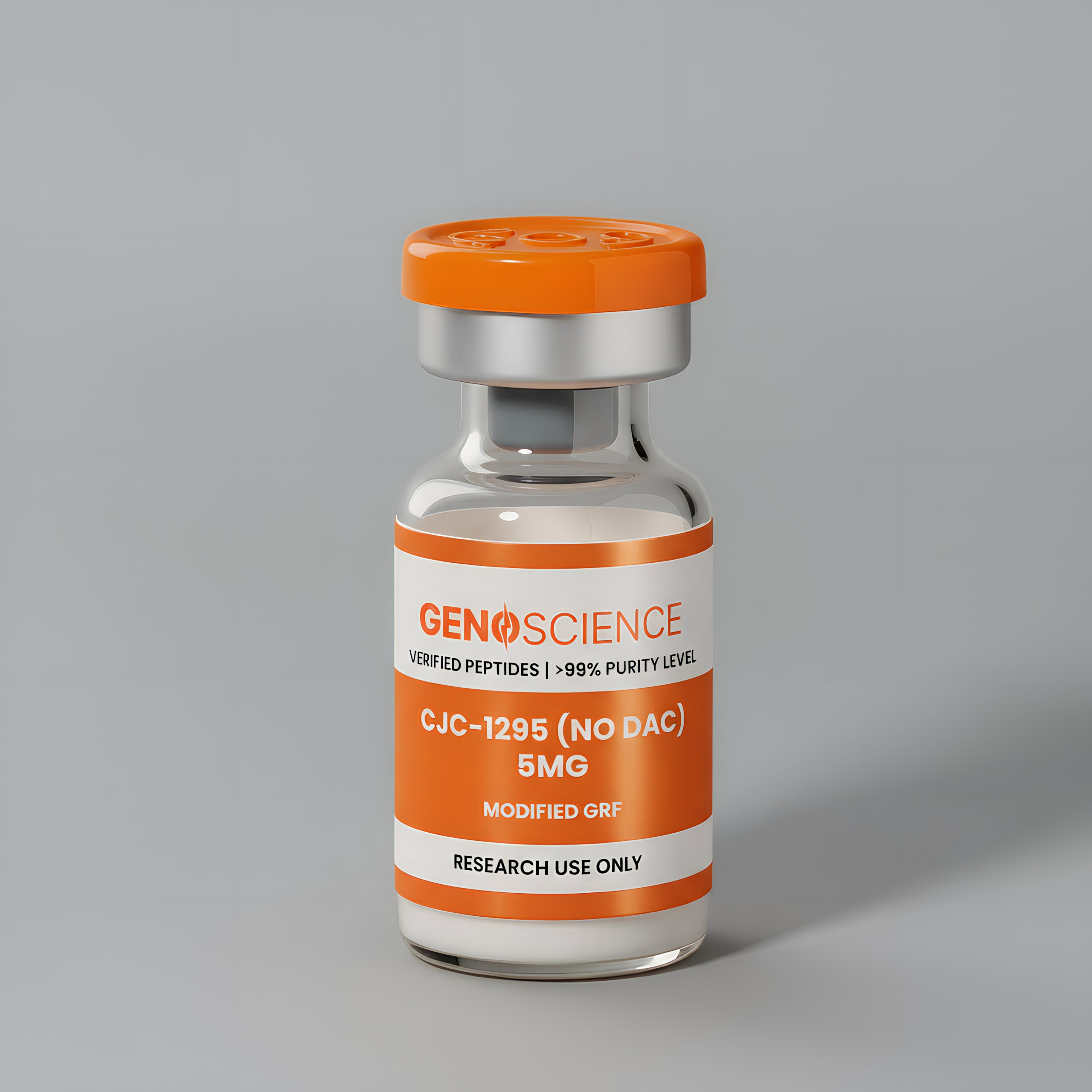



Compound: CJC-1295 No DAC (Modified GRF 1-29)
Amount: 5mg per vial
Format: Lyophilized Powder
Chemical Classification: Synthetic 29-Amino-Acid GHRH Analog
Research Target: Growth Hormone-Releasing Hormone Receptor (GHRHR)
Chemical Profile: CJC-1295 No DAC, also described as Modified GRF (1-29), is a modified 29-amino-acid analog of growth hormone-releasing hormone. Four amino-acid substitutions distinguish this sequence from native GRF (1-29). The No DAC form lacks the albumin-binding drug affinity complex associated with the long-acting DAC version. It is studied in research involving GHRH receptor signaling and peptide structure.
Research Use Only. Not for human or veterinary use.
CJC-1295 No DAC is the common product name for Modified Growth Hormone-Releasing Factor (1-29), abbreviated Mod GRF (1-29). It is a synthetic analog of the first 29 amino acids of human growth hormone-releasing hormone (GHRH).
The peptide incorporates four amino-acid substitutions associated with studies of enzymatic stability and receptor activity. Its research target is the GHRH receptor (GHRHR), which is distinct from the ghrelin receptor investigated with compounds such as ipamorelin.
The No DAC designation indicates that the peptide does not include the drug affinity complex used in an albumin-binding version of CJC-1295. This distinction is important because literature involving the DAC version should not automatically be attributed to this material.
| Specification | Details |
|---|---|
| Compound | CJC-1295 No DAC |
| Synonym | Modified GRF (1-29), Mod GRF 1-29 |
| Classification | Synthetic GHRH Analog |
| Peptide Length | 29 Amino Acids |
| Primary Receptor Target | GHRHR |
| Structural Substitutions | D-Ala2, Gln8, Ala15 and Leu27 |
| Molecular Formula | C152H252N44O42 |
| Molecular Weight | Approximately 3,367.9 g/mol |
| DAC Modification | Absent |
| Product Form | Lyophilized Powder |
| Amount | 5mg per Vial |
| Intended Use | Laboratory Research Only |
Tyr-D-Ala-Asp-Ala-Ile-Phe-Thr-Gln-Ser-Tyr-Arg-Lys-Val-Leu-Ala-Gln-Leu-Ser-Ala-Arg-Lys-Leu-Leu-Gln-Asp-Ile-Leu-Ser-Arg-NH2
Modified GRF (1-29) comprises the modified 29-residue GHRH-related sequence without a drug affinity complex. The long-acting DAC variant includes a chemical group designed to bind albumin.
The two names are sometimes used interchangeably in product discussions, but the molecular preparations are not identical. Published studies involving albumin-binding CJC-1295 address a different formulation from the No DAC peptide.
CJC-1295 No DAC is associated with research on the growth hormone-releasing hormone receptor. GHRHR is a G-protein-coupled receptor studied in pituitary and neuroendocrine systems.
GHRH-related ligands are investigated through receptor-binding and cell-based signaling experiments. These research methods examine the relationship between peptide structure, receptor recognition and downstream molecular responses.
Modified GRF (1-29) belongs to the group of synthetic GHRH analogs designed to retain the receptor-targeting framework of native GHRH.
Native human GHRH contains 44 amino acids, while its N-terminal 29-residue sequence has been investigated as a shorter receptor-active peptide fragment.
Laboratory investigations of GRF (1-29) analogs examine how amino-acid substitutions change peptide properties compared with the original sequence. This work provides scientific context for Modified GRF (1-29).
The precise substitution pattern matters when comparing different GHRH analogs, even when they are all described using similar names.
The four named modifications in Modified GRF (1-29) are D-Ala2, Gln8, Ala15 and Leu27. They replace residues in the native sequence while retaining a 29-residue peptide backbone.
Researchers study changes in amino-acid identity and stereochemistry to understand peptide recognition, stability and degradation pathways. In particular, D-amino-acid substitutions may influence susceptibility to certain proteases.
Such structure–activity investigations are foundational to peptide chemistry and are separate from claims about the clinical effects of an individual laboratory product.
Unmodified peptide hormones may be broken down by enzymes in biological samples or laboratory systems. GHRH analog development includes research on substitutions intended to modify this susceptibility.
Modified GRF (1-29) can be described in this research context because its sequence incorporates stabilizing substitutions. However, the absence of the DAC group distinguishes its chemical design from albumin-binding CJC-1295.
Stability observed for a DAC-containing formulation should not automatically be assigned to a No DAC preparation.
The term DAC refers to a drug affinity complex designed to support covalent interaction with albumin. The albumin-binding chemistry of CJC-1295 with DAC was investigated in published research on GHRH analogs.
CJC-1295 No DAC lacks this appended albumin-binding group. For technical comparisons, the No DAC compound and the DAC-modified compound should be treated as distinct structures.
Studies describing prolonged effects of CJC-1295 through albumin binding specifically address the DAC-containing material rather than the No DAC peptide.
Ipamorelin and Modified GRF (1-29) are frequently discussed in the same research area but act through different receptor families:
This difference is useful in receptor-comparison studies. It does not establish a specific combined effect from the two compounds in a mixture.
Research Use Only: This product is intended strictly for laboratory research and development.
Not for Human or Veterinary Use: Not intended for human consumption, administration or veterinary applications.
Not an Approved Medicine: This material is not marketed as an FDA-approved drug or treatment.
Research Limitations: Findings involving the DAC-containing version of CJC-1295 do not establish the clinical properties or efficacy of the No DAC research material.
CJC-1295 No DAC, also called Modified GRF (1-29), is a synthetic 29-amino-acid GHRH analog studied in receptor signaling and peptide structure research.
It means the peptide does not include the drug affinity complex associated with an albumin-binding version of CJC-1295. The two preparations have different chemical structures.
Both are discussed as modified GHRH-related peptides. The DAC version includes an albumin-binding chemical group, whereas the No DAC version is Modified GRF (1-29) without that appended group.
Genoscience supplies the compound as 5mg of lyophilized research material per vial.
Modified GRF (1-29) is associated with the GHRH receptor, while ipamorelin is a GHSR-1a ligand. They are distinct compounds studied in different receptor pathways.
When available, the COA for CJC-1295 No DAC (Mod GRF 1-29) 5mg can be found on the product page. You may also contact Genoscience to request a COA or ask about documentation availability for a specific lot.
No. Genoscience sells CJC-1295 No DAC strictly for laboratory research purposes. It is not intended for human or veterinary use.
$120.00 Original price was: $120.00.$100.00Current price is: $100.00. / month
$180.00 Original price was: $180.00.$140.00Current price is: $140.00. / month
$160.00 Original price was: $160.00.$120.00Current price is: $120.00. / month
$270.00 Original price was: $270.00.$200.00Current price is: $200.00. / month
$255.00 Original price was: $255.00.$200.00Current price is: $200.00. / month
$350.00 Original price was: $350.00.$220.00Current price is: $220.00. / month
You must be at least 21 years old to enter Genoscience and review products intended for laboratory research use only.
Products are not for human or veterinary use, not for use in diagnostic procedures, and have not been evaluated by the U.S. Food and Drug Administration.